


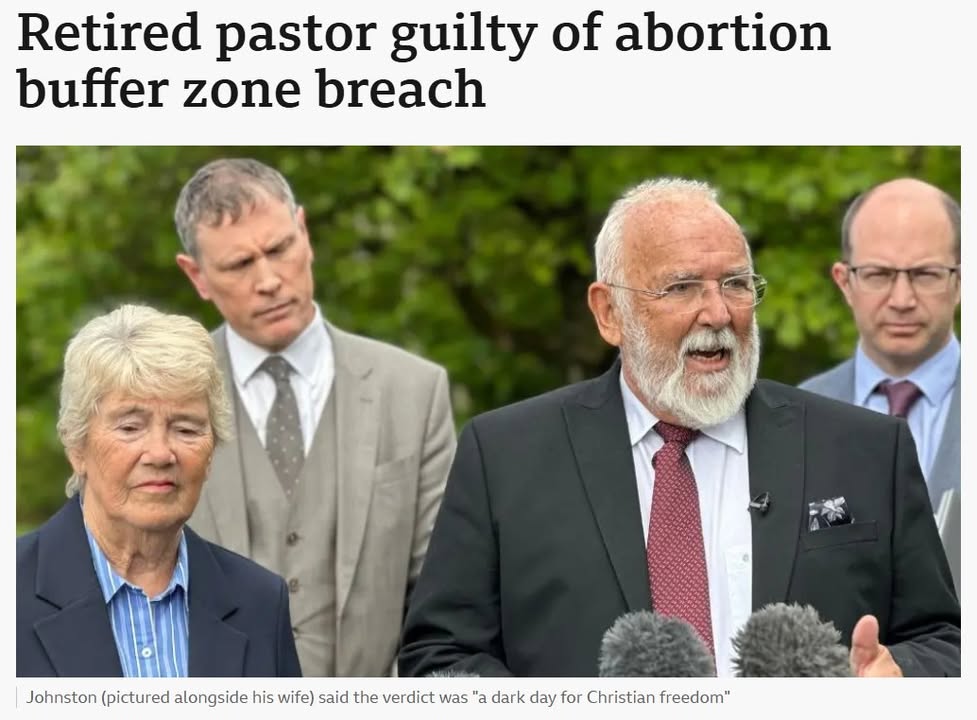
As Christians ourselves, we know this is not a “dark day for Christian freedom.” It may be, however, a wake-up call to a particular kind of assumed and entitled Christian privilege.
And that’s what Christian lobbyists like the Christian Institute are really afraid of losing. Not freedom, but privilege.
To be clear, Clive Johnston was not persecuted for preaching the gospel. He was held to account for intentionally breaching a designated safe access zone.
Safe access zones exist for a reason.
They are there to protect people accessing legal healthcare from harassment, intimidation, pressure, and unwanted confrontation at moments that may already be deeply private, painful, complex or vulnerable.
Christians should welcome such protections, not seek to undermine them.
Yes, of course Christians have the right to hold religious convictions. We have the right to gather, worship, pray, preach, organise, campaign, write, speak and advocate.
But that right does not mean we are entitled to impose our religious views on people in every public space – especially not by amplifying them at people who have not asked to be our audience.
We all know the kind of obnoxious street “preaching” that mistakes volume for courage, bravado for witness, and public nuisance for faithfulness. And many ordinary, faithful Christians are just as fed up with it as the rest of the general public.
And more often than not, we don’t even recognise the words being shouted as anything like the actual message of Jesus. It is usually just a narrow, fundamentalist version of Christianity, propped up with a scattering of carefully selected, out-of-context Bible verses.
We know that Jesus did not coerce. Jesus did not harass. Jesus did not dominate. Jesus did not force himself upon the vulnerable.
So yes, Christians should care about freedom of religion. But we should also care about freedom from religious intimidation. We should care about the difference between sharing actual good news, and just shouting bad theology at strangers.
And we should be honest enough to admit that much of what passes for “bold Christian witness” in public is not brave, not loving, and certainly not Christlike. It is usually just fundamentalist entitlement with an amplifier.
A sincerely held faith does not need to be obnoxious. Deep religious conviction does not need to be intrusive or combative.
And Christian freedom does not give us the right to ignore other people’s dignity, vulnerability and boundaries.
Safe access zones should be respected by everyone.
Not because Christianity has nothing to say (it absolutely does) but because real love knows how not to make itself the centre of the story.

(Feed generated with FetchRSS)