


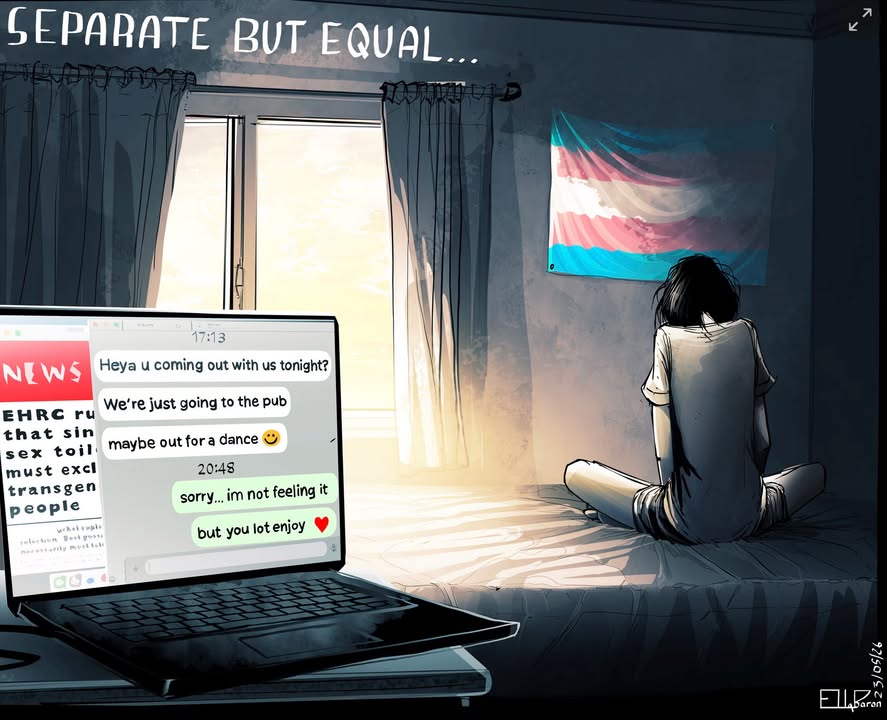
This…

With bitter irony, news that the Equality and Human Rights Commission had published it’s updated code of practice on trans rights began to filter through while I was playing a gig at the UK’s premiere venue for LGBTQ+ culture, the Royal Vauxhall Tavern in south London on Thursday night. The new code confirmed that single-sex spaces such as toilets and changing rooms must be used on the basis of biological sex, and that transgender people may not access those that accord with their lived gender.
The gig at the RVT was a celebration of the life of Mark Ashton, founder of Lesbians and Gays Support the Miners, whose story is told in the movie Pride. Mark died of AIDS in 1987, so there were many references to the political struggles of that decade, with Margaret Thatcher’s name being loudly booed whenever it came up. Had we been aware of the new EHRC code, it surely would have merited comparison to the notorious Section 28 anti-gay legislation which was referenced by several artists and speakers.
Section 28 of Thatcher’s 1988 Local Government Act prohibited local authorities from “promoting homosexuality” or teaching the acceptability of same-sex relationships. Its aim was to prevent local councils from funding LGBTQ+ positive initiatives, but its effect was to further marginalise the gay community at a time when they were in desperate need of public support due to the AIDS epidemic.
In seeking to dismiss the idea that they could be as fulfilling as heterosexual relationships, the legislation described same-sex couples as perpetrating “pretended family relationships”. This notion that gay and lesbian families were pretending to have fulfilling relationships was a spiteful slur. Despite Thatcher’s best efforts, same-sex relationships came be accepted by the public at large, to the extent that gay marriage became legal in the UK in 2013.
Section 28 was a ridiculous policy, a collection of impractical initiatives whose true aim was to deny the LGBTQ+ community the same respect accorded to other citizens and, worryingly, the new EHRC code seems to be cut from the same cloth. In their on-going campaign to eradicate the trans community from public spaces, anti-trans activists have badgered the EHRC into creating conundrums that, like those of Section 28, will defy practical application.
Determined to keep men out of women’s toilets, the demands of anti-trans activists have been met in the new code which declares that an individual must use the toilet that corresponds to the gender to which they were assigned at birth. So trans men are now banned by law from using the men’s toilets while women’s toilets must now be used by assigned female at birth individuals who present as male. Thus male predators, who previously had to dress in women’s clothing to gain access to female toilets, can now stroll in wearing their everyday male clothes.
The new code seeks to address this threat by stating that “a trans man may be excluded from women-only services if it’s decided that women may object to his presence.” Never mind the issue of who is going to decide if this criterion has been met – where is the guy supposed to piss? Banned from the men’s loos by law, excluded from the ladies by an arbitrary opinion based rule, what provision does the new code make for this situation?
My sense is that this new code will not withstand scrutiny under the European Convention of Human Rights. Faced with having to provide toilets for the trans community or be sued for discrimination, business will lobby the government to get real and recognise that the threat to women and girls – and to trans women too – comes from heterosexual men. The argument that recognising trans women as women undermines what it means to be female will come to be seen as being as ridiculous as the Section 28 argument that “promoting homosexuality” in schools will turn our kids gay.
Section 28 was finally repealed in 2003. It took fifteen years for people to recognise that it was a discriminatory policy concocted by homophobes. Hopefully, the government will recognise the transphobia implicit in the new EHRC code sooner than that, but in the meantime, our trans and non-binary siblings are going to be even more marginalised that they have been over the past decade.
The mood at the bar of the Royal Vauxhall Tavern after the show was one of anger and dismay at the existential threat posed by the new code. The LGBTQ+ community and their cishet allies need to come together as we did in the 1980s to campaign against this pernicious code and express our solidarity with the trans and non-binary communities whose continued presence in our society has become a form of resistance.
(Feed generated with FetchRSS)